


Cable Glands & Cord Grips
Cable glands and cord grips in this collection include nylon and metal fittings for securing flexible cables as they enter electrical enclosures. Different designs provide strain relief and, where specified, environmental sealing for equipment and panel connections. Choose by the cable jacket's outside diameter, the enclosure's hub or thread size, and installation conditions. Check each model's clamping range, environmental rating, and included mounting hardware before ordering, since fittings with the same hub size can accept different cable diameters.
Showing 41–60 of 85 results
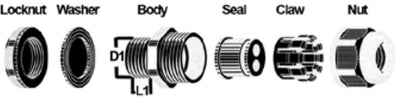
Morris 22292 Nylon Cable Gland - Multi-Conductor - NPT Thread, 10"
Morris 22291 Nylon Cable Gland - Multi-Conductor - NPT Thread, 10"
Morris 22290 Nylon Cable Gland - Multi-Conductor - NPT Thread, 10"
Morris 22289 Nylon Cable Gland - Multi-Conductor - NPT Thread, 10"
Morris 22279 Nylon Cable Gland - Multi-Conductor - NPT Thread, 10"
Morris 22278 Nylon Cable Gland - Multi-Conductor - NPT Thread, 10"
Morris 22277 Nylon Cable Gland - Multi-Conductor - NPT Thread, 10"
Morris 22276 Nylon Cable Gland - Multi-Conductor - NPT Thread, 10"
Morris 22275 Nylon Cable Gland - Multi-Conductor - NPT Thread, 10"
Morris 22274 Nylon Cable Gland - Multi-Conductor - NPT Thread, 10"
Morris 22263 Nylon Cable Gland - Multi-Conductor - NPT Thread, 10"
Morris 22262 Nylon Cable Gland - Multi-Conductor - NPT Thread, 10"
Morris 22261 Nylon Cable Gland - Multi-Conductor - NPT Thread, 10"
Morris 22260 Nylon Cable Gland - Multi-Conductor - NPT Thread, 10"
Morris 22259 Nylon Cable Gland - Multi-Conductor - NPT Thread, 10"
Morris 22258 Nylon Cable Gland - Multi-Conductor - NPT Thread, 10"
Morris 22257 Nylon Cable Gland - Multi-Conductor - NPT Thread, 3/4"-14
Morris 22254 Nylon Cable Gland - Multi-Conductor - NPT Thread, 3/4"-14
Morris 22247 Nylon Cable Gland - Multi-Conductor - NPT Thread, 10"
Morris 22246 Nylon Cable Gland - Multi-Conductor - NPT Thread, 10"
About Cable Glands & Cord Grips
How to Choose Cable Glands and Cord Grips for Electrical Enclosures
Cable glands secure flexible cables at enclosure entry points, helping protect electrical terminations from pulling forces and, where specified, limiting the entry of moisture and dust. The correct fitting depends on the cable jacket, the enclosure opening, and the installation conditions. A cord grip used on an indoor control panel may have different requirements from one installed on an outdoor pump enclosure. Before ordering, measure the cable's outside diameter, identify the enclosure connection, and check the required strain-relief and environmental ratings.
Quick Cable Gland Selection Guide
- Indoor control panel: Match a nylon or metal cord grip to the cable diameter and panel entry.
- Outdoor equipment enclosure: Check the fitting's wet-location suitability and required sealing hardware.
- Motor or pump cable: Verify cable retention, vibration exposure, and permitted bending conditions.
- Two cables entering one opening: Consider a purpose-built multi-hole gland with separately sized seals.
- Existing threaded enclosure: Confirm the exact NPT or other thread specification before ordering.
Cable Gland Sizes: Hub Size vs. Cable Diameter Range
The most important sizing distinction is between the gland's enclosure connection and the diameter of the cable it holds. These measurements describe different parts of the installation.
Hub size identifies the fitting's mounting connection. Cable diameter range identifies the minimum and maximum outside diameter that the sealing and gripping mechanism is designed to accommodate.
For example, Orbit model NGC38197394 is listed with a 3/8-inch nominal hub and a cable diameter range of 0.197 to 0.394 inches. A cable measuring 0.31 inches across its outer jacket falls within that published range, but the enclosure must also accept the fitting's mounting connection.
Other cord grips with the same hub size can have different clamping ranges. Likewise, a larger hub doesn't automatically mean the fitting accepts every smaller cable.
Measure the outside of the complete cable jacket using calipers. Don't use the conductor AWG, conductor count, or nominal cable description as a substitute for the actual outer diameter.
If the cable is close to either end of the gland's permitted range, verify the manufacturer's sealing and retention requirements before selecting it.
Selection rule: Match the cable's outside diameter to the published clamping range, then independently match the gland's hub or thread to the enclosure.
For new installations, coordinate the selected fitting with the specifications of the electrical wire and cable being used.
Nylon vs. Metal Cable Glands: Material and Application Differences
Nylon and metal cable glands can both provide effective cable retention when properly selected, but their material properties and permitted applications differ.
Nylon glands use nonmetallic bodies and are commonly selected for suitable equipment enclosures where low weight, corrosion resistance, or electrical insulation is desirable.
Some nylon formulations are suitable for outdoor exposure, but material and color alone do not establish UV resistance, operating temperature limits, or environmental protection ratings.
Metal cable glands are available in different constructions, including steel and nickel-plated brass. Their suitability depends on the required mechanical strength, corrosion resistance, temperature range, and product approval.
For example, the Morris 22601 metal cable gland uses nickel-plated brass construction and a 1/2-inch NPT connection. Its published specifications include an IP68 rating and a specified operating temperature range. Those ratings apply to that model, not every metal gland.
For an equipment enclosure located near a washdown area, don't choose between nylon and metal based solely on perceived durability. Verify the exact product's environmental rating, gasket compatibility, and resistance to the substances present at the installation site.
Selection rule: Choose material based on the specified mechanical and environmental conditions, then confirm the individual fitting's ratings and cable compatibility.
IP68 and Weatherproof Cable Glands: Protect the Complete Enclosure
A cable gland's environmental rating describes performance under specified test conditions. It does not automatically establish the protection rating of the complete enclosure after installation.
IP-rated fittings are evaluated for protection against solid objects and water. For example, IP68 identifies dust-tight construction and water-immersion protection under conditions defined by the manufacturer and applicable testing requirements.
An IP68 marking should not be interpreted as unlimited immersion capability or as automatic compliance with a particular NEMA enclosure rating.
Consider an outdoor control box with four cable entries. Even if the enclosure itself has a NEMA 4X rating, unsuitable cable fittings or missing sealing washers can compromise the protection of the installed assembly.
Before ordering fittings for exposed equipment, confirm:
- Ingress protection: The rating and conditions stated for the exact gland.
- Enclosure compatibility: The protection required at the complete cable-entry assembly.
- Sealing components: Whether a gasket, sealing washer, or O-ring is required.
- Cable jacket: Compatibility with the compression seal.
- Operating conditions: Temperature, moisture, chemical exposure, and mechanical stress.
For industrial equipment, compare the appropriate NEMA-rated electrical enclosures before choosing the entry fittings.
For exposed boxes and outdoor connections, review compatible weatherproof electrical boxes.
Selection rule: Treat the enclosure, cable gland, sealing hardware, and cable jacket as one assembly. Verify that the installation maintains the required protection rather than relying on the rating printed on a single component.
Single-Cable vs. Multi-Hole Cable Glands
A standard single-hole cable gland is designed to seal around one compatible cable jacket. Passing multiple separate cables through the same opening may prevent the seal from closing correctly unless the fitting is specifically designed for that arrangement.
Multi-hole cable glands use sealing inserts with separate openings for multiple cables. Each opening has a permitted cable diameter range, and the fitting must be installed according to the manufacturer's instructions.
For example, a control enclosure requiring two separate sensor cables may use a compatible two-hole gland instead of two individual cable entries. Morris manufactures multi-conductor NPT cable glands for applications requiring multiple sealed cable passages.
The number of holes, cable diameter range for each opening, and mounting connection must all match the planned installation.
An ordinary cable gland should not be drilled, cut, or modified to accommodate additional cables unless the manufacturer specifically permits that modification.
Selection rule: Use a multi-hole gland only when the exact product is designed and rated for the number and dimensions of the cables involved.
Cable Glands vs. Conduit Connectors: Which Fitting Do You Need?
Cable glands and conduit connectors can appear similar, but they secure different components.
A cable gland or cord grip is designed to retain a compatible cable jacket at an enclosure entry. Depending on its construction, it may also provide sealing against dust or moisture.
A conduit connector terminates a specified raceway, such as electrical metallic tubing, at an electrical box or enclosure. Its connection and approval requirements are based on the raceway rather than the outside diameter of a flexible cord.
For example, an electrical installation using 3/4-inch EMT requires a connector approved for that tubing and installation environment. A 3/4-inch cord grip is not an interchangeable substitute.
For raceway installations, compare appropriate EMT connectors and couplings.
Where the installation requires protection at the end of a conduit rather than strain relief for an outer cable jacket, review conduit and grounding bushings.
Selection rule: Identify whether the fitting must retain a cable jacket or terminate a raceway. Choose the listed product intended for that specific wiring method.
Cable Gland Installation: Locknuts, Seals, and Strain Relief
Correct installation is necessary for a cable gland to provide its intended mechanical retention and environmental protection. A fitting with the appropriate dimensions can still perform poorly if the seal is damaged or the cable is not secured correctly.
Before installation, check whether the gland is designed for a threaded entry or mounting through an unthreaded enclosure opening.
Some configurations require a separate locknut. Others use an approved threaded connection or include specific mounting hardware. Never assume that all gland kits contain the same components.
For example, a cable gland installed in a sheet-metal control cabinet may require a suitable locknut and sealing washer, depending on the enclosure and manufacturer's instructions.
During installation:
- Check the cable jacket: Use the specified sealing area without damage or irregularities.
- Verify the enclosure entry: Confirm hole dimensions, thread type, and panel thickness.
- Install required seals: Use the manufacturer's approved washers, gaskets, or O-rings.
- Follow tightening instructions: Avoid insufficient compression or excessive tightening that damages the jacket.
- Respect bend radius: Do not force a sharp bend immediately beyond the fitting.
- Inspect the connection: Verify cable retention and the required environmental protection.
For cable runs subject to repeated movement or vibration, check whether a specialized strain-relief arrangement is required. A conventional straight gland does not automatically provide the same bending protection as a fitting designed for dynamic cable movement.
Where the cable enters a wiring enclosure, review suitable junction boxes and enclosures and confirm that the wiring remains accessible as required.
For conductor terminations inside the enclosure, use appropriate electrical wire connectors when the connection method calls for them.
Flexible cord must be used only where permitted by the applicable electrical code. Cable glands do not authorize flexible cord as a substitute for permanent building wiring.
Electrical installation should be performed by qualified personnel following the manufacturer's instructions and applicable electrical requirements.
Ordering Cable Glands and Cord Grips for Electrical Projects
For a project with several enclosure entry points, prepare a fitting schedule before ordering. A panel containing six cables may require different clamping ranges even if the enclosure openings share the same nominal hub size.
Include the following details:
- Manufacturer and exact part number
- Nylon, steel, brass, or other specified material
- Cable outside diameter and number of cables per gland
- Enclosure thread type, hub size, and mounting dimensions
- Required environmental and strain-relief ratings
- Locknut, gasket, or sealing washer requirements
- Installation quantity and packaging details
Eligible business buyers can review Lumera Electric's trade account options for recurring electrical material purchases.
Request a Quote for Cable Glands and Cord Grips
For larger orders or projects requiring multiple cable-entry configurations, request a project quote from Lumera Electric.
Provide the fitting schedule, manufacturer part numbers, cable diameter ranges, required quantities, and environmental specifications. Include any special sealing or mounting hardware requirements so the complete material list can be reviewed before ordering.
Cable Glands & Cord Grips FAQs
What is the difference between a cable gland and a cord grip?
The terms are often used interchangeably for fittings that secure a cable jacket at an enclosure entry. Both may provide strain relief and environmental sealing, depending on the design. Some manufacturers use cord grip primarily for cable-retention fittings and cable gland for sealing configurations. Choose by the actual ratings and specifications rather than the product name alone.
Does a 1/2-inch cable gland fit a 1/2-inch cable?
Not necessarily. The 1/2-inch designation commonly identifies the nominal mounting hub or thread size, not the cable diameter the gland accepts. Each product has a separate cable clamping range. Measure the cable's outside jacket diameter, then select a gland whose permitted range includes that measurement and whose mounting connection fits the enclosure.
Are nylon or metal cable glands better for outdoor use?
Neither material is universally better. Appropriately rated nylon glands can provide corrosion resistance and suitable outdoor performance, while certain metal glands offer different mechanical and environmental characteristics. The exact product's UV resistance, temperature range, sealing rating, and corrosion suitability determine whether it fits the installation. Material alone does not establish outdoor approval.
Are all cable glands waterproof?
No. Environmental protection varies by product. Some glands are designed primarily for strain relief, while others provide specified liquid-tight, dust-tight, or immersion-related protection. Even an IP68-rated gland must be installed under its stated conditions. The enclosure, mounting interface, sealing hardware, and cable jacket must also be suitable for the required environment.
Can multiple cables pass through one cable gland?
Yes, when the gland is specifically designed for multiple cables. Multi-hole glands use separate sealing passages and have permitted cable ranges for each opening. An ordinary single-hole gland should not be used for several separate cables unless the manufacturer approves the arrangement. Check the number of holes, individual cable diameters, and sealing instructions before ordering.
Does a metal cable gland automatically provide electrical grounding?
No. Metal construction alone does not establish a suitable equipment grounding or bonding connection. Certain specialized cable glands are designed to terminate cable armor or shielding, but their electrical continuity and bonding ratings must be verified for the exact product. Follow the approved grounding and bonding arrangement rather than relying on physical contact between metal components.