Shopping Siemens Breakers When the Panel Is Full
Plenty of breaker orders are routine swaps, but the calls that
actually stress a counter involve panels that ran out of room or
services that outgrew a standard interrupt rating, and the Siemens shelf
happens to be organized around exactly those problems. Tandems, quads,
and the 22kA units are the specialty tools here, sitting beside the
everyday QP singles and doubles, and this page takes the shelf in that
order of drama, least to most. The cross brand aisle these all belong to
is circuit breakers.
Type QP: The Everyday Plug-In
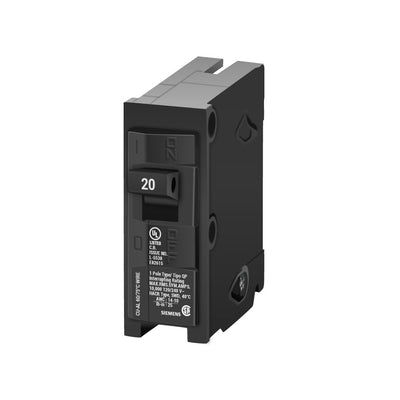
The backbone of the shelf is the Q numbered plug-in line, units like
the Q225, a 25A two pole at 120/240V with 10kA interrupt and thermal
magnetic trip, the format that fills most positions in a compatible
Siemens load center. The titles state everything the schedule needs, so
ordering is a matter of matching the panel's label to the breaker type
and reading amps and poles off the drawings. These install only in
panels listed for them, which the panel door confirms before anything
else matters.
Tandems and Quads: Circuits Beyond Spaces
The Q2030 style QT tandem puts two independent circuits into one
panel space, and quad units like the Q22040CT go further by packing
multiple poles into a doubled body, which is how a full panel takes on
new circuits without a subpanel project. The catch is that panels accept
these only in designated positions and quantities, stated on the
panel's own labeling, so count the eligible slots before counting the
breakers. Where the load has genuinely outgrown the gear, the upstream
equipment conversation moves to power and distribution.
The H Suffix and the 22kA Question
Units like the Q220H carry a 22kA interrupt rating instead of the
standard 10kA, and that number is the breaker's ability to safely open
against the maximum fault current the service can deliver. Services
close to large utility transformers can present more fault current than
10kA gear is rated to interrupt, which makes the H units a code
requirement in those spots, not an upgrade. The available fault current
figure comes from the utility and the service design, a determination
that belongs with a licensed electrician, and whole panel protection
pairs naturally with the surge protection aisle.
BQ and BQD: The Molded Case Step Up
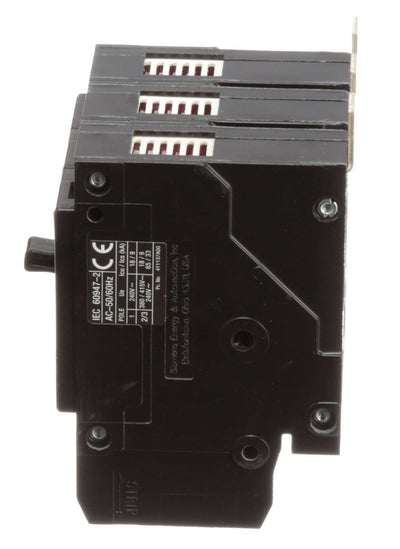
Past the residential line the shelf climbs into BQ molded case units,
two and three pole bodies like the 90A BQ2B090 and the 50A three pole
BQ3B050, and the BQD series, bolt-on breakers rated at 277VAC in single
pole formats like the 60A BQD160, the voltage that marks commercial
lighting panelboards. Bolt-on mounting and the higher voltage class both
come from the panelboard's specification, so these are ordered off
equipment documentation rather than by analogy to the house panel. The
transformers feeding those 277V systems sort under transformers.
Building the Siemens Order
The reliable sequence is panel label first, positions second,
breakers last: confirm the load center or panelboard accepts Siemens
types, map which slots take full size units and which accept tandems or
quads, then transcribe the schedule with amps, poles, and interrupt
rating per line, the same order the titles here read in. Breaker work
happens at live equipment and stays in a licensed electrician's scope
from the first cover screw, and the conductor terminations completing
each position size from lugs by wire range.
Siemens Breaker Questions
Can I put a tandem breaker anywhere in the panel?
No. Panels designate which positions accept tandems and how many
total, printed on the panel's labeling and diagram. Exceeding that count
or using undesignated slots violates the listing even when the breaker
physically fits, so the panel documentation sets the ceiling before the
order does.
When is a 22kA breaker required instead of 10kA?
When the available fault current at the panel exceeds 10,000 amps,
which happens on services near large transformers or with short, heavy
service conductors. The figure comes from the utility and the service
calculation, a licensed electrician confirms it, and the breaker rating
must meet or exceed it.
What is the difference between BQ and BQD breakers?
Both are molded case lines, but the titles split them by duty: the BQ
units here list 120/240V duty in two and three pole bodies, while BQD
units bolt on and carry 277VAC ratings for commercial lighting
panelboards. The panelboard's specification names which one it takes.
Do Siemens breakers fit other brands' panels?
Order as if the answer is no. A panel's label lists the breaker types
it accepts, and matching that listing is what keeps the installation
compliant, so read the door label first and buy the family it names
rather than trusting that a breaker which snaps in belongs there.