


Ceiling Fan Controls
Ceiling fan controls manage motor speed and, where supported, separate fan and light functions from the wall or a compatible remote. Choose by motor type and current rating, the wiring available between the switch and fan, and the control method the installation requires. AC and DC motor fans do not use the same speed-control approach, and combination fan/light controls need compatible wiring. For repeated room layouts, verify these three conditions before standardizing devices or quantities.
Showing 81–88 of 88 results
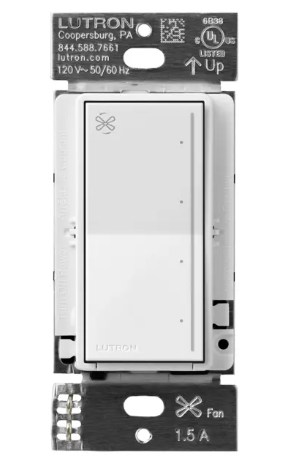
Lutron Sunnata 4-Speed Fan Control 1.5 A RRST-ANF

Enerlites 3 Speed Fan Control Switch - Slide 17000-F3-LA

Lutron Diva Fan and Light Control 1.5 A DVSCFSQ-LF Series 1

Lutron Maestro Fan Control RK-F

Lutron Maestro Fan Control 2 A RRD-2ANF

Lutron Pico Wireless Remote PJ2-3BRL-F01 Series 1

Lutron Diva Fan and Light Control 1.5 A DVFSQ-LFH

Lutron Diva Fan and Light Control 1.5 A DVFSQ-LF
About Ceiling Fan Controls
How to Choose Ceiling Fan Controls for Speed, Light, and Remote Operation
The right ceiling fan control depends on the fan motor, the wiring already in the ceiling and wall boxes, and how you want to operate the fan. Start by identifying whether the fan uses an AC or DC motor, then check the motor’s current rating and the conductors available between the wall box and fan. After that, choose between a hardwired wall control, combination fan-and-light control, or compatible remote system. A lighting dimmer is not a substitute for a fan-rated speed control.
- Need control without running another wall conductor? Review wireless remotes and companion controls.
- Need ordinary on/off switching rather than speed control? Compare standard switches.
- Need to dim the fan’s light separately? Use a compatible LED dimmer for the lighting load.
- Planning connected controls across several rooms? Review smart controls.
Match the Control to the Fan Motor and Amp Rating
Fan controls are motor-load devices, so current rating matters more than the number of speed buttons on the face. Read the motor nameplate and use the full-load current of every fan connected to the control. If one wall control operates more than one fan, add those motor currents together and stay within the control manufacturer’s rating.
A single residential ceiling fan may need far less capacity than a control serving several motors. Decision rule: size the control from the actual fan motor current, not from the branch-circuit breaker or an estimated wattage. If the load only needs basic on/off operation, a properly rated wall switch may be enough.
Confirm Whether the Fan Uses an AC or DC Motor
Conventional wall fan-speed controls are commonly designed for compatible AC ceiling-fan motors. DC-motor fans operate through onboard electronics and usually rely on the control system specified by the fan manufacturer. A generic wall speed control placed ahead of a DC fan should not be assumed compatible.
If the fan documentation identifies a proprietary receiver or remote, use that control architecture rather than trying to replace it with a standard wall regulator. For a retrofit where the original handheld control is missing or inconvenient, check compatible wireless remotes only after confirming the receiving system and model compatibility.
Check the Existing Wiring Before Choosing Fan-and-Light Control
Separate wall control of fan speed and light level normally requires separate control paths to the ceiling fixture. If only one switched conductor runs from the wall to the fan, a conventional dual wall control cannot independently command both loads through that single conductor.
A fan replacing an old ceiling light is a common example. If the box only has one switched leg, the practical retrofit may be a receiver in the fan canopy paired with a compatible remote. If separate fan and light conductors are already present, a hardwired combination control can be considered. Lumera’s ceiling fan control wiring guide explains the two-wire and three-wire layouts.
Choose Wall Control, Remote, or Smart Control by How the Room Is Used
A hardwired wall control is simple for daily use and does not depend on a handheld device. A remote can be more practical for high ceilings, finished rooms, or retrofits where adding conductors is difficult. Smart controls add scheduling, automation, or app-based operation when the fan and control system support those features.
For a bedroom fan used every night, permanent wall speed control may be the simplest choice. For a vaulted ceiling with limited wiring access, a receiver-and-remote arrangement can reduce new wiring. If the project needs broader automation, coordinate the fan controls with compatible smart-control equipment rather than assuming every remote fan can join the same ecosystem.
Keep Fan Speed Control Separate From Light Dimming
Fan motors and lighting loads require different control electronics. A standard light dimmer is designed around a lighting load and should not be used to regulate a ceiling-fan motor unless the device manufacturer explicitly rates it for that motor function. Likewise, a fan-only speed control is not a general lighting dimmer.
When the fan includes a light kit, either use a purpose-built combination fan-and-light control or separate the two functions into compatible devices. The light side can use an appropriate LED dimmer when the lamp or integrated lighting system supports dimming. Lumera’s fan controls and remotes guide explains the distinction.
Finish the Wall Control With the Correct Box and Plate Layout
Combination fan/light controls, smart devices, and side-by-side fan and lighting controls can require more box space than a basic switch. Check device depth, conductor space, gang count, and any manufacturer instructions that apply when several controls share one box.
If the fan control and separate light dimmer occupy a 2-gang box, select the devices first and then match the finished openings. Lumera’s wall plates and switch plates can be selected by gang count and opening style once the controls are known. Installation should be handled by a qualified electrician who can verify conductors, grounding, load compatibility, and the fan-supporting ceiling box.
Ordering Ceiling Fan Controls for Larger Projects
For multi-room, hospitality, residential, or repeated floor-plan projects, organize the control schedule by fan model, AC or DC motor type, full-load current, fan-only or fan-and-light function, wall wiring, remote requirements, device style, and quantity. Keeping each control tied to the exact fan prevents visually similar but electrically incompatible controls from being mixed across rooms.
Request a Ceiling Fan Control Project Quote
For larger quantities or projects with repeated fan-control configurations, request a project quote after the fan and wiring schedule has been verified.
Have these details ready:
- Fan manufacturer and model
- AC or DC motor type
- Motor full-load current
- Fan-only or fan-and-light control
- Number of conductors available at the wall and fan
- Hardwired, remote, or smart-control requirement
- Number of control locations
- Wall-plate and gang requirements
- Quantity by room or fan
Repeat electrical buyers can also review Lumera Electric’s trade account options when coordinating controls across larger projects.
Ceiling Fan Control FAQs
Can I use a regular light dimmer to control ceiling fan speed?
No. A lighting dimmer is designed for a different electrical load and should not be used as a fan-speed control unless the manufacturer specifically identifies it for that motor application. Use a fan-rated control for the motor and a separate lighting dimmer for a compatible light kit.
What amp rating should my ceiling fan control have?
Use the full-load current shown on the fan motor nameplate and select a control rated for that motor load. When one control serves several compatible fans, add their current requirements and follow the manufacturer’s multi-motor and derating instructions. Do not size a fan control from the branch-circuit breaker rating alone.
Can one wall control operate both the fan and light separately?
Yes, when the wiring and the selected control support separate fan and light circuits. If only one switched conductor runs to the ceiling fan, a hardwired wall device cannot independently control both loads through that conductor. Lumera’s fan-control wiring guide shows the common wiring arrangements.
Will a standard wall fan control work with a DC ceiling fan?
Generally, no. DC ceiling fans use onboard electronics and are typically controlled through the system specified by the fan manufacturer. Confirm the exact fan documentation before adding any external speed control. Where the fan uses a dedicated receiver, a compatible remote may be the appropriate replacement or additional control point.
Should I choose a wall control or a remote?
Choose a wall control when compatible wiring is already present and you want a fixed, battery-free control point. A remote can be more practical when the room lacks separate fan/light conductors or when the fan is difficult to reach. Lumera’s ceiling fan controls and remotes guide compares both approaches in more detail.